Tampilkan postingan dengan label Kuih. Tampilkan semua postingan

Rabu, 23 Maret 2016

PANDAN ONDE-ONDE

This is my favourite Nyonya Kuih.  I have tried several recipes for this kuih and so far, I'm pleased with the results and never failed to enjoy them to the fullest.  Eventhough it is my favourite, I do share some with my relatives and friends.
My first recipe here is a good one but this recipe below has an extra ingredient 'sweet potato'.  The end result is the same and you wouldn't notice that there are sweet potatoes in it.  I used the white sweet potatoes and the gula melaka [palm sugar] is from a friend who bought it in Melaka. I like it very much cos' it is aromatic and fine.  Good to use as filling for Onde-onde as it melts in the mouth.
These Onde-onde are made for this friend who will be transferred to KL next month.  
Recipe adapted from the book - Nyonya Flavours
Ingredients
1 medium size yellow or white sweet potato - steamed, peeled and mashed
250 gm glutinous rice flour
5-6 pandan leaves - washed and cut small pieces
250 ml water to extract the juice
150 gm palm sugar - chopped coarsely
200 gm grated white coconut
1/4 - 1/2 tsp fine salt to taste
  1. Mix grated coconut with salt and set aside in the fridge.
  2. Blend pandan leaves with water and extract the pandan juice.
  3. In a large mixing bowl, mix sweet potatoes with glutinous rice flour and gradually add in the pandan juice.  Knead until smooth, add water if more moisture in required to work it into a fairly stiff dough.
  4. Divide dough into small balls [size of marbles].  Make a well in the centre of each ball and place some chopped palm sugar, sealed well and roll into a ball.
  5. Meanwhile, bring water to boil in a pot.  Drop balls into boiling water to cook as you make them.  When the dough floats up, it is cooked.  Dish up using a serrated ladle and roll them with grated coconut.

Kamis, 03 Maret 2016

NIAN GAO [LUNAR CHINESE NEW YEAR CAKE]

This is a scheduled post. 
I came across this Nian Gao recipe in one of my food magazines and is quite skeptical if it is a workable recipe. In the recipe, there is no water to mix with the glutinous flour except coconut milk. With the quantity given, it is impossible to obtain a sticky batter [thick consistency like condensed milk]. To play safe, I added 250 ml water together with the coconut milk to knead the flour into a rough dough before adding in the sugar. This way the sugar will melt easily when mix with the wet dough.
With this batter, it cooks within 3 hours instead of the usual 8-10 hours.  The dark brown sugar gives an intense brown colour to this cake.  It is aromatic with the coconut milk.  If you like to enjoy Nian Gao within hours, this is a good recipe to use.  
By the way, Nian Gao is a sticky sweet snack, was believed to be an offering to the Kitchen God [Taoist faith] on the 24th day of the 12th month of the lunar calendar, with the aim that his mouth will be stuck with the sticky cake, so that he can't badmouth the human family in front of the Jade Emperor.

Recipe adapted from my selected cookbook for Cookbook Countdown Event #3] - Home Cooking Magazine [January 2001] with modifications 

Ingredients
[makes 5 pieces]
500 gm glutinous rice flour - sifted
250 ml water
250 ml thick coconut milk
200 gm dark brown sugar
100 gm sugar

  1. Sift flour into a big bowl, add in water and coconut milk.  Mix into a rough dough.
  2. Add in both sugars and mix until it becomes a thick batter and sugars are dissolved.
  3. Bring water to boil in a steamer, wrap the cover with cloth to prevent water condensation.
  4. Line steaming moulds with cling wrap or banana leaves.  Pour batter into moulds until the height you prefer.
  5. Place in steamer and steam over high heat for 15 minutes, then reduce to medium low heat and simmer for a further 3 hours until batter is cooked through.
  6. Remove from steamer to cool before removing from moulds.  Trim off the excess cling wrap.
Note:  This rice cake can be sliced into desired thickness and size to be fried with beaten eggs.  Coat sliced rice cake with egg, pan fry for a few minutes, turning once to ensure even coating.  Serve.

I'm submitting this post with Cookbook Countdown hosted by 

Senin, 28 Desember 2015

PANDAN ABOK ABOK SAGO

There are so many ways of making Kuih Sago. It can be wrapped with banana leaves or place in small teacups or in a steaming tray, then steamed to cook.
The original recipe here uses banana leaves to wrap the sago mixture, then steamed to cook. This is a more tedious and laborious way, so I just made it easier by steaming it in a steaming tray.
The kuih is soft and chewy, not too sweet and has a very aromatic pandan flavor that always seems to blend well with palm sugar.  Tips - this kuih is only good for a day - best to prepare and serve immediately after completely cooled.
Recipe adapted from Ricky Ng’s book ‘In Love With Pandan’ - modified
Ingredients
[use 6 inch square tin lined with cling wrap or a piece of greased banana leave]
250 gm pearl sago
30 gm castor sugar
25 gm coconut milk powder *
250-260 ml water *
2 tbsp pandan paste
80-100 gm grated white coconut
¼ tsp salt
100 gm palm sugar [gula Melaka] – finely chopped
*can use 160 ml thick coconut milk with 100 ml water
  1. Rinse sago quickly in a colander and drain off excess water [crucial step].
  2. Mix sago with all the ingredients well [except palm sugar]. Set aside.
  3. Prepare steaming tray. Scoop half the sago mixture into tray, spread out evenly. Spread chopped palm sugar all over mixture, then top up with balance sago mixture. Smooth batter.
  4. Steam with boiling water over high heat for 30 minutes or until sago is cooked through [looks transparent and shiny].
  5. Remove pan and leave to cool completely before slicing. Coat with extra grated coconut if preferred.
Cook-Your-Books

This post is linked to Cook Your Books Event #29 [December 2015] hosted by Joyce of Kitchen Flavours

Selasa, 22 Desember 2015

PANDAN COCONUT CAKE [PUTERI AYU] “香兰”椰丝糕

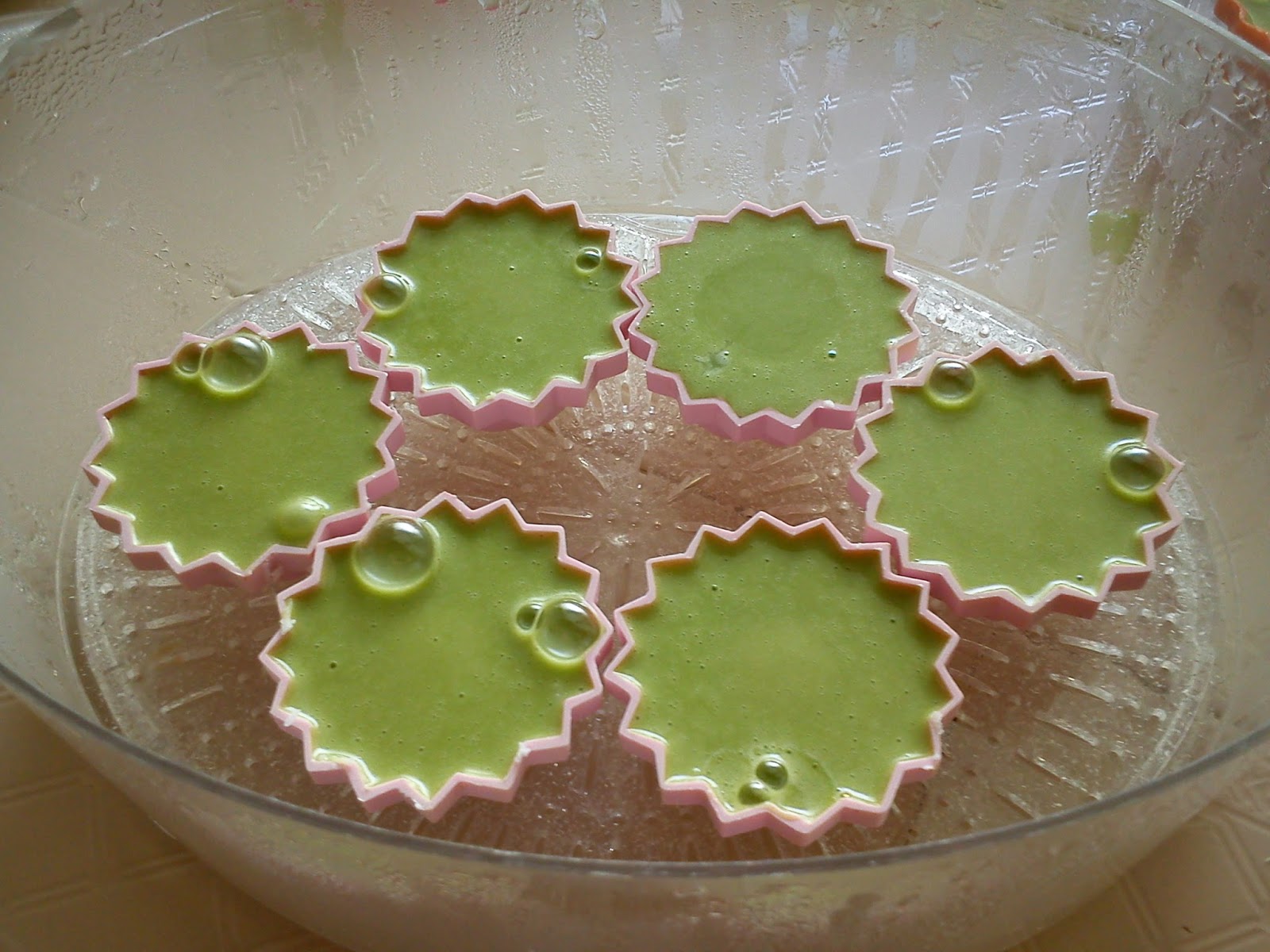
Recently made these kuihs because my MIL gave me some of the Puteri Ayu molds and my neighbor gave lots of pandan leaves she cut from her garden.
Frankly speaking, I have not really tasted this kuih, so I didn't know exactly how to describe whether these that I made is good.  But I believe this is an easy and good recipe to follow.  Probably, with practice I may get better looking kuihs and more skillful in removing the kuihs from the molds. [Updates-Please read Amelia's comment on this.  She has answered my doubts.  I will make another batch with this step].
These kuihs are very aromatic and the natural colour is from the pandan leaves.
Recipe adapted from Joceline lyn
Ingredients
[makes 16 pieces]
50 ml coconut milk [椰奶]
50 ml pandan juice [香兰汁]
2 eggs [蛋]
100 gm sugar [糖]
125 gm superfine flour [低粉]
120 gm fresh shredded coconut [嫩椰丝]
  1. Mix well coconut milk with pandan juice, set aside.
  2. Whisk eggs and sugar until thick, then sift in half the flour and gently mix well.   Repeat with the remaining flour.
  3. Gradually drizzle in the coconut/pandan mixture and mix well.
  4. Press shredded coconut into the greased molds. Then pour the batter into it.
  5. Put into the steamer and steam for 15 minutes over high heat.
  6. Remove and cool before unmolding kuih.